

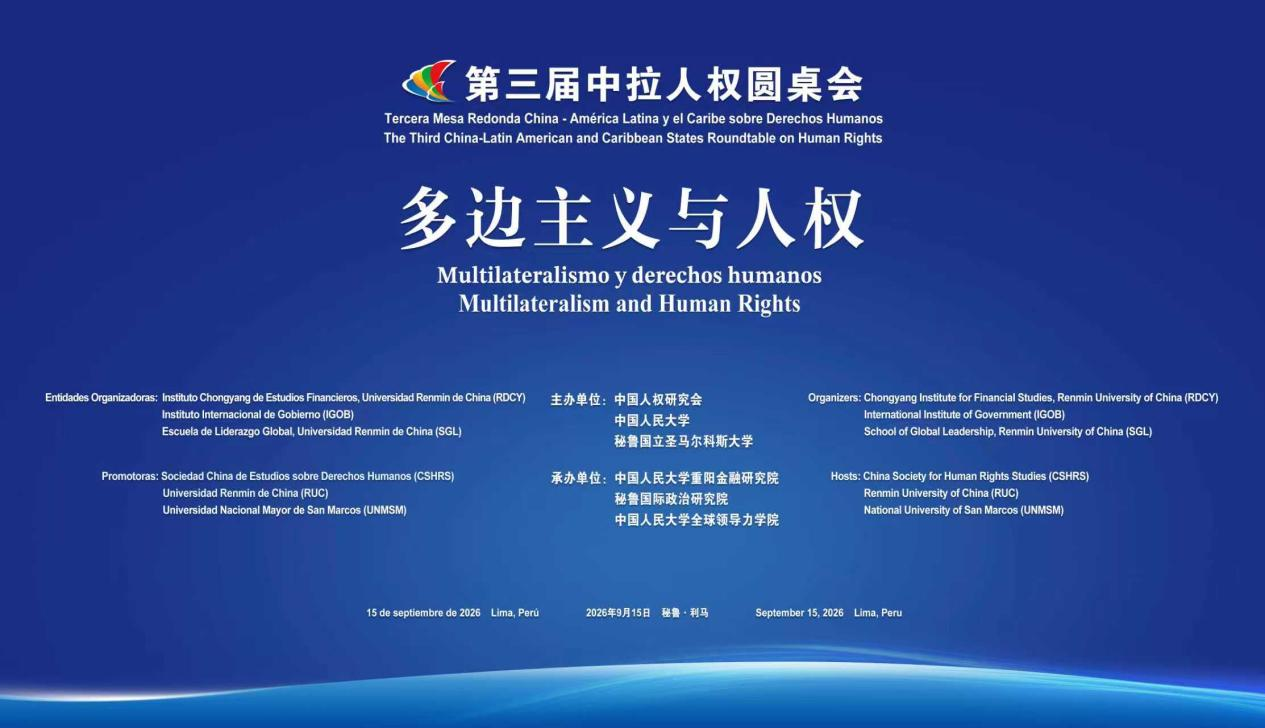
The Third China-Latin American and Caribbean States Roundtable on Human Rights, themed "Multilateralism and Human Rights," was held in Lima, Peru, Sept. 15, 2026. [Photo provided to China.org.cn]
The Third China-Latin American and Caribbean States Roundtable on Human Rights, themed "Multilateralism and Human Rights," was held in Lima, Peru, on Sept. 15, bringing together nearly 200 delegates from China and 23 Latin American and Caribbean nations, making it the largest edition of the event to date.
The event was jointly hosted by the China Society for Human Rights Studies (CSHRS), Renmin University of China (RUC) and the National University of San Marcos in Peru (UNMSM), with the Chongyang Institute for Financial Studies at RUC (RDCY), the International Institute of Government (IGOB) in Peru, and the School of Global Leadership at RUC as co-organizers.
Ma Huaide, vice president of CSHRS and president of RUC, said that China and Latin America and the Caribbean are both important forces in the Global South and staunch defenders of international fairness and justice. The two sides share highly compatible values and practical aspirations in the field of human rights. Deepening dialogue on human rights between China and Latin America and the Caribbean will help promote mutual learning between the two sides and provide an example for developing countries to participate in global human rights governance, he said.
Gustavo Pacheco Villar, founding president of the IGOB, said that in contemporary society, human rights also include the right to access and use technology and new technologies. The Global AI Governance Initiative proposed by China is advancing this process and will help create a space for a shared future, he said.
Song Yang, Chinese ambassador to Peru, said that although China and Latin American and Caribbean countries are separated by mountains and seas, they share the common aspiration of pursuing people's well-being and achieving development and progress. He explained that over the years, the two sides have explored paths of human rights development suited to their respective national conditions, and also accumulated rich experience in safeguarding the rights to subsistence and development, and promoting fairness and justice.
Isabella Teixeira, former environment minister of Brazil, said that in the face of a changing international landscape, Latin America should uphold multilateralism, promote more balanced international cooperation, further advance human rights protection, and offer more solutions to regional and global challenges.
Participants from China and Latin America and the Caribbean took part in a series of in-depth discussions. These included a themed roundtable dialogue and three parallel forums on "Peaceful Development and Human Rights Governance," "China-Latin America and Caribbean Practical Cooperation and Human Rights Development" and "Exchanges and Mutual Learning among Human Rights Civilizations."
During the event, the China-Latin America and Caribbean Human Rights Academic Research Action Plan 2026-2030 was launched. Meanwhile, an expert committee under the China-Latin America and Caribbean Human Rights Research Cooperation Network was established, with certificates presented to newly appointed committee members. The network also released its joint research projects for 2026-2027.
Over the next five years, the two sides will leverage the action plan to advance cooperation in areas including youth talent development, joint research projects and expert network building. These efforts will deepen China-Latin American and Caribbean exchanges on human rights, inject greater people-to-people strength into building a China-Latin America and Caribbean community with a shared future, and contribute Chinese and Latin American and Caribbean wisdom and solutions to the reform of the global human rights governance system.
