

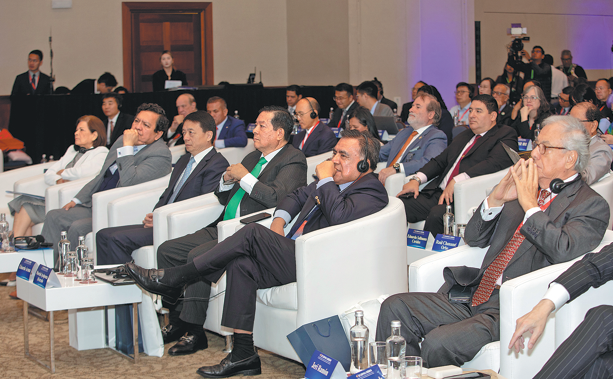
Guests attend the third China-Latin American and Caribbean States Roundtable on Human Rights in Lima, Peru, on Tuesday. XINHUA
Senior officials and scholars from China and Latin American and Caribbean countries say the right to development is a crucial human right for Global South countries, calling for true multilateralism to improve human rights governance amid global challenges.
They made the remarks at the third China-Latin American and Caribbean States Roundtable on Human Rights, held on Tuesday in Lima, Peru, under the theme "Multilateralism and Human Rights". The roundtable gathered nearly 200 attendees.
Ma Huaide, vice-president of the China Society for Human Rights Studies and president of Renmin University of China, said current international human rights governance faces serious deficits and challenges, with some countries arbitrarily resorting to armed intervention and unilateral sanctions to maintain hegemonic power.
Practicing true multilateralism to reform and improve global human rights governance has become a common call of developing countries, he said.
Eduardo Melchor Arana Ysa, former prime minister of Peru, said the right to development is a crucial human right for Global South countries, noting that freedom and dignity are out of the question when food, clothing and housing are lacking.
Human rights are universal, but development paths vary across countries because of different histories, cultures and national conditions, he said, adding that China's poverty reduction practices prove the priority value of the rights to subsistence and development.
The AI era brings new challenges to the right to development, he said, urging efforts to prevent technology from further widening the North-South divide.
Latin America should uphold sovereign independence, avoid falling into the trap of choosing sides among major powers, and build its own capabilities through broad international cooperation, he said, adding that true multilateralism should manage differences through dialogue and ensure the technological revolution benefits all people.
Chinese Ambassador to Peru Song Yang said that despite the vast geographical distance, China and Latin American and Caribbean countries share a common pursuit of enhancing people's well-being and seeking development.
Both China and LAC countries have explored human rights development paths based on their respective national realities, accumulating extensive practical experience in safeguarding the rights to subsistence and development, Song said.
Security is the most fundamental aspect of people's well-being and a universal human right, he said. China is committed to leveraging technology to enhance public security governance, making China one of the countries with the lowest homicide rates, he said. China stands ready to join hands with LAC countries to transform technological progress into a force for safeguarding people's security, he added.
China has also proposed establishing the World AI Cooperation Organization, a move echoed by Brazil and others, so more Global South countries can benefit from AI development, and has pushed the use of an AI-powered meteorological warning system to help more countries bridge the technological divide, Song said.
Gustavo Pacheco Villar, founding president of the International Institute of Government in Peru, praised China's achievement in lifting hundreds of millions of people out of poverty and eradicating extreme poverty, saying this accomplishment deserves greater international recognition.
He underscored that the right to life is paramount, with wars and armed conflicts directly depriving individuals of it.
In modern society, human rights include the right to use science and technologies, he added. He highlighted China's contribution of about 40 percent of global AI-related output, its provision of technological training, and its promotion of inclusive technology.
The Global AI Governance Initiative proposed by China is advancing this process to create a shared future, he said.
The roundtable was hosted by the China Society for Human Rights Studies, Renmin University of China, and the National University of San Marcos in Peru. The Chongyang Institute for Financial Studies and the School of Global Leadership at Renmin University of China and the International Institute of Government in Peru organized it.
