

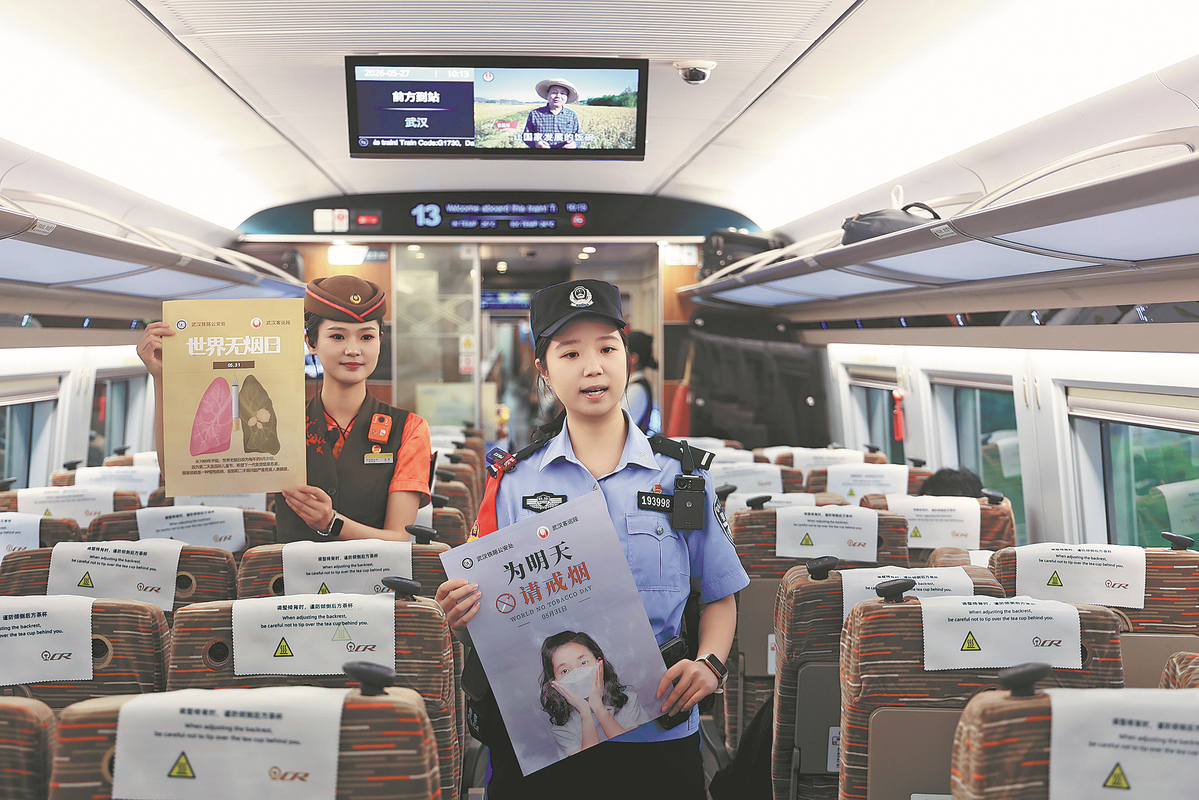
A railway police officer and a train attendant promote no-smoking awareness aboard a train in Wuhan, Hubei province, on May 27. XIONG ZHENDI/FOR CHINA DAILY
A coalition of 16 public health, tobacco-control, and environmental protection groups is calling on China to impose a nationwide smoking ban on all conventional trains and railway platforms, arguing that partial restrictions are no longer sufficient to protect passengers from secondhand smoke.
The proposal, released ahead of World No Tobacco Day, observed annually on May 31, argues that only a full prohibition across all rail services and station platforms would align China's obligations under the World Health Organization Framework Convention on Tobacco Control, which took effect in China two decades ago and requires smoke-free environments in indoor public spaces and public transport.
China has already fully banned smoking on high-speed electric multiple unit, or EMU, trains — fast, modern services that carry nearly three-quarters of the country's rail passengers, according to transport authorities. These trains are designed as sealed, air-conditioned carriages where air circulates internally, making smoking incompatible with ventilation systems.
However, the proposal notes that smoking restrictions on conventional trains — slower, older services that still serve large parts of the country — remain inconsistent. Out of 18 regional railway operators, only a small number, including those in Wuhan, Hubei province and Jinan in Shandong province, as well as the Qinghai-Xizang region, have implemented comprehensive smoking bans on all conventional trains.
"Designated smoking areas, smoking carriages or ventilation systems cannot effectively eliminate the hazards of secondhand smoke," said Li Kewei, a technical officer for the tobacco-free initiative at the WHO China Office."Only a full smoking ban can truly protect all passengers and crew."
The proposal was jointly issued by organizations including the China Association on Tobacco Control for Health, a branch of the Chinese Preventive Medicine Association, regional health education, tobacco-control, and environmental protection bodies in Beijing, Shanghai, Yunnan and Jiangxi.
Public health experts say secondhand smoke exposure is linked to serious illnesses including heart disease, chronic obstructive pulmonary disease, respiratory infections and diabetes. "Though many women don't smoke, secondhand smoke has claimed the lives of innocent nonsmoking women," said Jiang Yuan of the ThinkTank Research Center for Health Development.
The debate has surfaced in China's courts before. In 2017, a university student sued a railway operator after being exposed to secondhand smoke on a train that allowed designated smoking areas.
A court later ordered the removal of smoking signs and ashtrays in a ruling widely seen as a milestone for advancing smoke-free rights protection.
Experts say enforcement remains uneven. Huang Biaowen, an associate professor at Beijing Jiaotong University, said the controversy reflects broader tension between public health protections, railway safety management and gaps in existing regulations.
He also noted practical challenges, including the cost of retrofitting older train fleets and limited enforcement capacity.
Conventional trains typically have enclosed, air-conditioned carriages, and smoke can easily spread between compartments and carriage connections, the proposal said. Crowded platforms, where passengers often wait for extended periods, also expose nonsmokers to secondhand smoke, it added.
Some cities have already designated platforms as nonsmoking zones, but advocates are pushing for a unified national rule covering both trains and stations.
"A smoking ban is not a restriction on freedom, but a protection for the freedom of more people," the proposal stated.
China's railway system is one of the world's largest, carrying billions of passengers annually, making any nationwide tobacco-control expansion a significant public health and enforcement challenge.
