

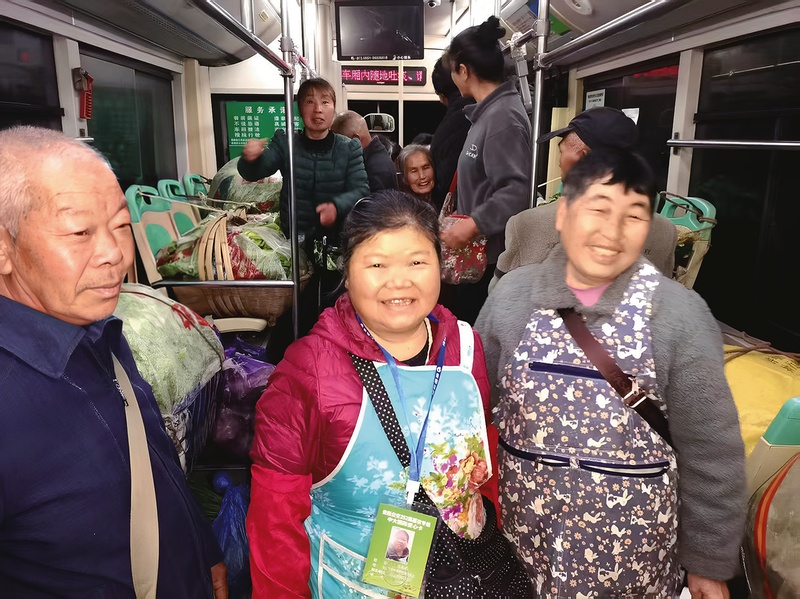
Photo shows farmers on bus route No.252 in Guiyang, southwest China's Guizhou province. (Photo/Du Gaofu)
A video captured by American social media influencer Jackson Hinkle in southwest China's Guizhou province has sparked considerable interest overseas. It showcases an ordinary yet revealing scene: Guiyang city's pre-dawn "Vegetable Bus" -- Route No. 252.
This specialized bus service helps local farmers transport their fresh produce into the city at minimal cost. While outwardly unremarkable, the bus features detachable storage racks. The driver assists farmers, acting as a porter to lift shoulder poles and load vegetable baskets. The passengers are local growers heading to city markets at daybreak.
The video resonated with international viewers. Comments praised the "simple but efficient" solution, the "smiles on their faces," and described China as "a country full of care." Through this relatable microcosm, many glimpsed the workings of China's grassroots governance.
The power of the "Vegetable Bus" lies in its directness. It eschews grand gestures to address concrete rural needs: early-morning transport, moving produce, and market access costs. Details like detachable shelves, direct routes, and low fares embody a governance philosophy centered on improving daily life.
Hinkle observed that challenges often deemed difficult by American elites were addressed in China by a practical solution like a dedicated bus route. This comment, though casual, touches on a key feature of China's approach: prioritizing tangible solutions over rhetoric for ordinary people's problems.
This approach manifests in various forms nationwide.
In Beijing, residents collaborate in "courtyard discussion halls" on issues from laundry drying to neighborhood planning. In Hubei province, volunteer "alley stewards" address community concerns like clearing clutter. In Chongqing, officials hold "courtyard meetings" with villagers to discuss industry and infrastructure.
The methods differ, but the principle is consistent: bringing governance to the community level ("the last mile"), empowering residents as active participants, and making governance a direct, shared experience.
Strikingly, this people-centered approach resonates across cultures. Somalia's Ambassador to China, Hodan Osman Abdi, admired the "handle matters with at most one trip" slogan at a community center, calling China's governance "remarkable." A Nepalese delegation visiting a township committee meeting was impressed to see democracy deeply integrated into practice, not just theory.
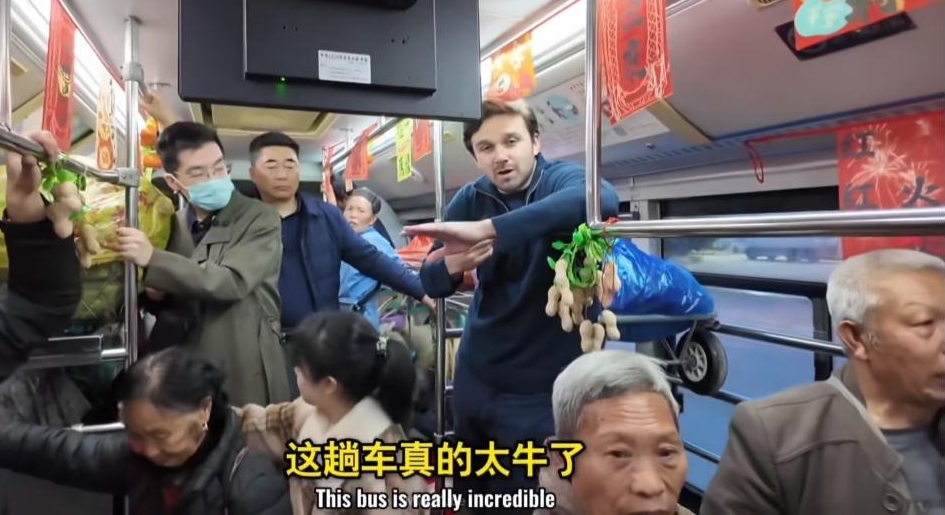
American influencer Jackson Hinkle talks with farmers on bus route No.252 in Guiyang, southwest China's Guizhou province. (Screenshot of a video)
International students and foreign businesspeople in China are even participating in local governance, serving as volunteer coordinators or cultural mediators. Their participation reflects not only recognition of the effectiveness of China's grassroots governance, but also the broader appeal of a people-oriented approach that transcends borders.
From the "Vegetable Bus" to courtyard discussions, China's diverse grassroots governance practices showcase the unique character of its modernization.
This path is defined not just by economic growth, but also by responsive, humane governance. It translates the abstract principle of "putting people first" into tangible realities: a warm sunbeam on an early bus, a cup of tea easing tensions, and the quiet certainty felt by ordinary citizens that they are valued and cared for.
This, perhaps, is the most compelling insight China's governance offers the world.
