

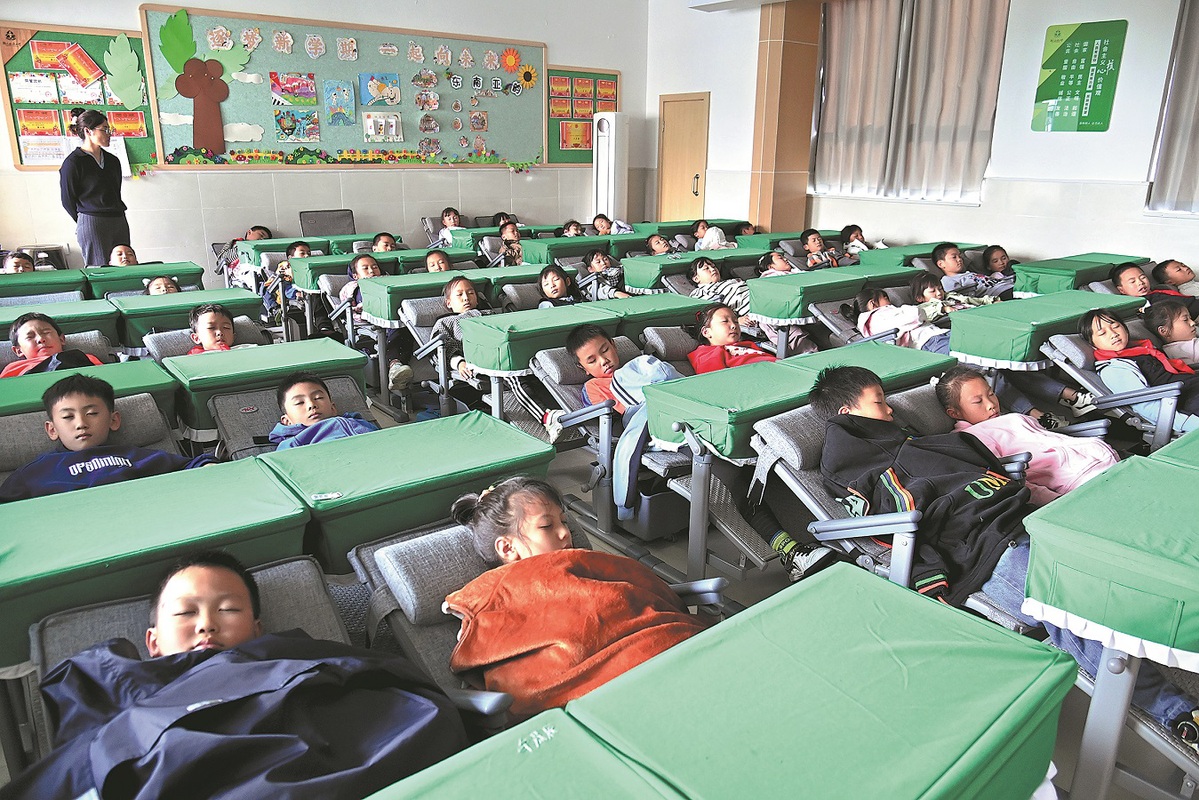
Students from a primary school in Chongqing take a nap on their new desks and chairs designed for a lie-down rest in November. [Photo provided to China Daily]
More schools across China have begun helping students lie down for a proper rest during the midday break, since a national standard for primary and secondary school desks and chairs took effect in February.
In Wuhu, Anhui province, the government's 2026 livelihood projects include 468 sets of lie-down napping equipment for compulsory education schools. Some local schools have already introduced the gear, enabling students to say goodbye to uncomfortable desk-napping.
The new equipment features adjustable backrests and extendable seats. During class, it functions as a standard chair. At lunch break, a few simple steps transform it into a comfortable mini-recliner, relieving the neck and arm strain associated with bent-over napping.
In September 2025, the State Administration for Market Regulation (the National Standardization Administration) issued the national technical standard for student napping desks and chairs. Taking physical development into account, the standard sets requirements for seat height, reclining angle, underdesk space, and material durability.
Currently, the daily schedule for primary and secondary schools generally includes about two hours for lunch and rest.
"Students who get a good nap after lunch are better able to regain their energy and also enhance the efficiency of the class in the afternoon," said Lu Xiao, mother of a primary school student in Dalian, Liaoning province.
"I hope students in my son's school can use the adjustable backrests and extendable seats as soon as possible," she said.
Even before the new standard, relevant policies had been introduced. In 2021, the Ministry of Education issued a notice on strengthening student sleep management, specifying recommended sleep durations and encouraging schools with the necessary conditions to guarantee an adequate lunch break.
In 2023, the State Council issued a policy supporting schools in expanding classroom activity spaces and sports grounds to create napping conditions.
Zhang Qiongli, a national legislator and young teacher from Enshi High School in Hubei province, proposed a suggestion to improve the lunch break methods for primary and secondary school students in 2023 and quickly received positive responses.
"Nearly 40,000 primary and secondary school students in Enshi Tujia and Miao autonomous prefecture have achieved 'lying sleep' during lunch breaks. I also hope that in the future, all primary and secondary school students across the country can achieve lying lunch breaks," she told reporters.
In recent years, a number of schools have piloted lie-down napping programs, promoting a shift from desk-napping to lying down. The market for napping-friendly desks and chairs has grown accordingly. However, uneven quality and safety among various products highlighted an urgent need for unified standards — leading to the new national standard.
This spring, about 2,000 sets of lie-down desks and chairs were put into use in several primary and secondary schools in Urumqi, Xinjiang Uygur autonomous region.
In Shenzhen, Guangdong province, more than 400 primary and secondary schools have already implemented napping improvement programs. In the new semester, the city plans to enable another 200 schools to offer comfortable lie-down napping, upgraded to meet the latest national standard.
Despite these efforts, the number of schools that have taken the initiative to provide such conditions remains relatively small. The full promotion of lie-down napping faces practical challenges including space constraints, funding pressures, and management complexities.
