

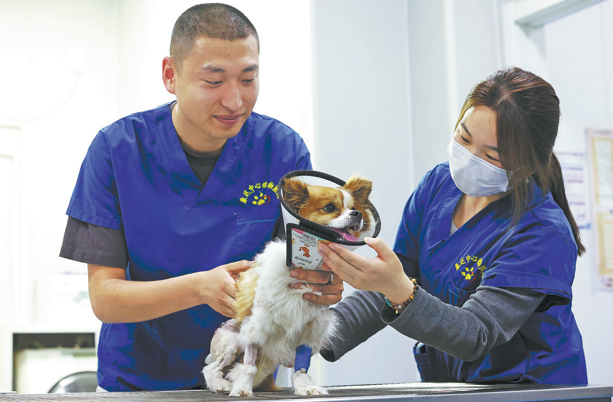
Teng Zhewen (left) and his colleague take care of a dog at Kangda Pet Hospital's Jinzhong branch in Shanxi on April 1. ZHU XINGXIN/CHINA DAILY
In the provincial capital of Shanxi, the "pet economy" is transcending traditional retail. Driven by a younger generation that views animals as family members, the market in Taiyuan is pivoting toward a professionalized ecosystem that includes high-speed rail transport, standardized in-home care, and advanced geriatric veterinary medicine.
Chen Hong, a 40-year-old pet sitter, has become a key figure in this burgeoning industry. On a recent job, she donned disposable shoe covers and gloves and sprayed disinfectant before entering a client's home. Immediately, two cats approached and began affectionately rubbing against her legs.
"More and more people consider their pets as family members and emotional anchors. As a result, pet owners are increasingly demanding higher quality services," Chen said, as she gently played with the cats.
With eight years' experience with her own cat, Chen made the transition to full-time pet sitter last winter. Her services primarily cater to owners who are traveling or on business trips, providing in-home feeding, cleaning and play time.
Chen's career path is a reflection of the rise of new pet service professions in Shanxi and across China. She navigates through various communities in Taiyuan daily, handling five to six appointments on average, with demand surging to over a dozen during peak holiday seasons.
According to the 2026 China Pet Industry White Paper, there are nearly 126 million dogs and cats in urban China, with a market size reaching 312.6 billion yuan ($45.5 billion). The report forecasts that by 2028, the pet industry's consumption scale will expand to 405 billion yuan.
Unlike traditional boarding, in-home pet sitting aligns better with the natural habits of animals and is favored by many owners. Zhang Zining, a 28-year-old resident of Taiyuan, owns an Abyssinian cat. Whenever she plans to travel for more than two days, she books in-home pet sitting services.
.png)
Pet sitter Chen Hong uses her mobile phone to document her work at a residential complex in Taiyuan, Shanxi province, on March 28. ZHANG AO/FOR CHINA DAILY
"My cat is a high-demand pet. It becomes inactive when I'm not home and needs about an hour of play time daily," she said. Zhang also mentioned her concerns about the stress pets can experience outside their familiar environment and the hygiene standards of pet boarding facilities. Keeping her pet at home provides peace of mind.
The widespread availability of home surveillance has further alleviated pet owners' concerns, making the process of in-home pet sitting more transparent and safer.
Many independent pet sitters operate solo, with the industry lacking standardized regulations and oversight. In response, some leading pet service companies have begun to standardize operations by implementing service agreements and purchasing liability insurance to protect the interests of both parties.
"The pet industry has a promising future, and the demand for personalized services is growing," Chen said. To ensure service quality, she drafts agreements with clients in advance, detailing the pet's health status and the sitter's service responsibilities.
Pet owners' increasing willingness to spend has also driven growth in everything from clothing and food to housing and transportation. Xue Yijing, from Yuci district in Jinzhong city, Shanxi, has a 15-year-old Labrador. She spends nearly 3,000 yuan annually on dog food, treats and hygiene products, and regularly takes her dog to pet stores for grooming.
As the pet market in Shanxi continues to expand, the number of related specialty stores and veterinary clinics has increased and many supermarkets are offering dedicated pet product sections.
Pet transport services have also improved. Since Jan 28, China's railway department has expanded its high-speed rail pet transport trial to include 67 additional stations, such as Taiyuan, Harbin in Heilongjiang province, and Shenyang in Liaoning province. It totals 110 stations nationwide, with 170 routes offering pet transport services.
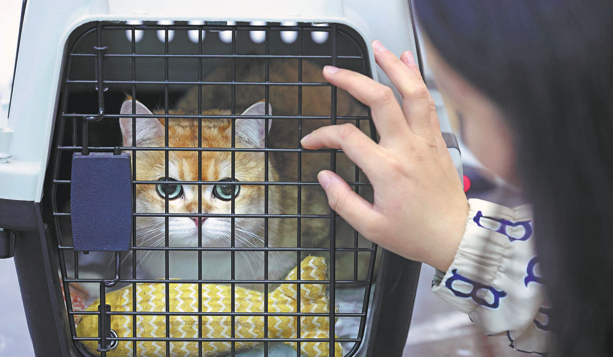
A cat is kept in a pet transport box at the Taiyuan South Station branch of China Railway Express. ZHU XINGXIN/CHINA DAILY
Feng Xiaojing, who transported her cat from Taiyuan South Station to Beijing, shared her experience. "The pet transport box was equipped with a fresh air system, cameras and real-time environmental monitoring," she said. "I could check on my cat anytime via my phone, and staff provided litter in advance, making the journey very reassuring."
Compared to air transport, high-speed rail stations are often more centrally located, offering more convenient access and transparent procedures.
"I'll choose high-speed rail for future trips with my pet. It feels wonderful to travel together," Feng said.
Wu Xin, business manager at the Taiyuan South Station branch of China Railway Express, said that travelers can book pet transport services through the official 12306 platform or at the branch office, where staff regularly check on the animals and provide necessary care and hydration.
As the pet economy thrives, Shanxi is seizing the opportunity to develop it further. At present, the province has 377 animal clinics and over 2,200 pet-related service outlets, forming a comprehensive industry ecosystem that includes pet products, boarding and medical care. "Owners' awareness of pet healthcare has significantly increased. They routinely deworm, vaccinate, and conduct health checks for their pets, and seek medical attention promptly when their pets fall ill," Teng Zhewen, director of Kangda Pet Hospital's Jinzhong branch, told China Daily.
Medical services have expanded beyond routine vaccinations and spaying and neutering to include exotic pet care, genetic testing, comprehensive health management, and geriatric pet care, Teng said.
"The number of pet hospitals is growing, and industry competition is becoming more intense. We are continuously improving in medical technology, staff training and diagnostic equipment, particularly in specialized surgeries like orthopedics and ophthalmology," he added.
The exotic pet ownership community is also expanding, with the post-2000s generation becoming the primary consumers of exotic pets.
Teng said that in addition to common companion animals like dogs and cats, the hospital treats exotic pets such as lizards, snakes, parrots and rabbits. "Staff provide personalized care based on the living habits of different exotic pets to meet diverse healthcare needs," he said.
Zhao Yifan contributed to this story.
