

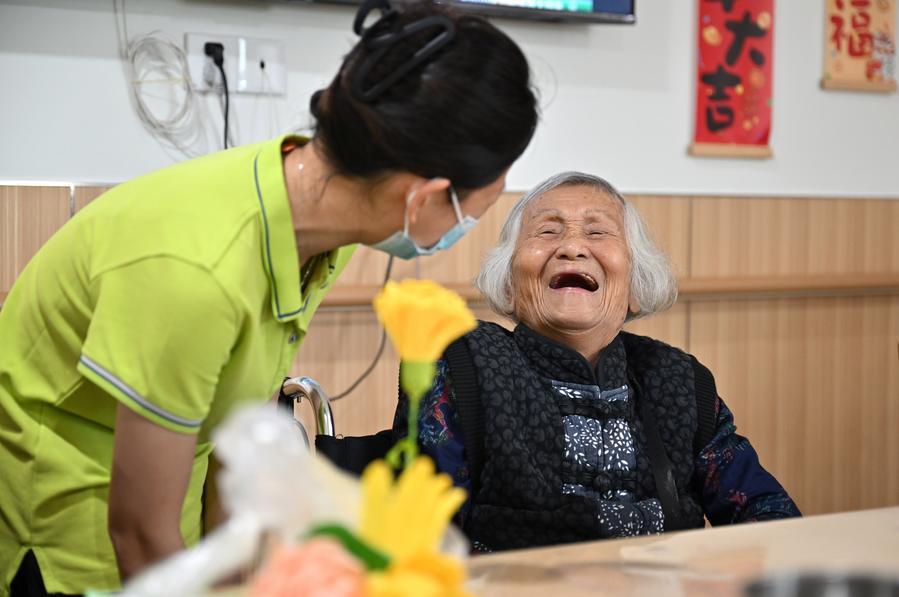
An elderly person chats with a staff worker at an elderly care service center in Qiongshan district of Haikou, South China's Hainan province, Oct 29, 2025. [Photo/Xinhua]
Ahead of the "two sessions", the annual meetings of China's top legislative and political advisory bodies, in March, Jin Hua, a national political adviser based in the Haixi Mongol and Tibetan autonomous prefecture, Qinghai province, conducted field research at a rural mutual-aid elderly care center in Dulan county, to further identify ways to improve elderly care services in high-altitude regions.
Jin, a member of the National Committee of the Chinese People's Political Consultative Conference, the country's top political advisory body, has spent much of the past year conducting on-site investigations in grassroots communities, elderly care institutions and residents' homes. Her goal is to ensure that the voice of the plateau's elderly is heard at the national level.
While China constructed over 140,000 rural mutual-aid elderly care service facilities during the 14th Five-Year Plan (2021-25), Jin noted that rural seniors living in scattered and remote areas on the high-altitude plateau need more specialized support to address their care challenges.
Furthermore, she found that while the number of nursing beds now could meet the needs of seniors with disabilities due to increased State investment, institutions in the region face low occupancy and a shortage of professional staff, largely due to the harsh climate and traditional attitudes toward elderly care.
"It's urgent to establish teams of village-level elderly care workers," Jin said. She emphasized the need to "effectively ensure that elderly people in remote areas are looked after and helped when they encounter problems".
For the upcoming session of the CPPCC National Committee, Jin plans to submit a proposal for guidelines for plateau medical-nursing institutions including critical services such as emergency oxygen supply, with the goal of providing better care for disabled seniors on the plateau.
Jin will be among around 2,100 CPPCC National Committee members gathering in Beijing in March for the annual session, where the formulation of the 15th Five-Year Plan (2026-30) will be a central focus.
The advisers will contribute their professional insights and submit proposals to serve as essential references for the decision-making of the Party and State, particularly during the first year of the new Five-Year Plan.
The consultative process is built upon a solid foundation of democratic supervision conducted over the past five years. From 2021 to 2025, the CPPCC National Committee conducted continuous oversight across 10 key areas to facilitate the implementation of the 14th Five-Year Plan.
These specialized supervision themes ranged from optimizing the business environment and black soil protection to the development of the Guangdong-Hong Kong-Macao Greater Bay Area, as well as accelerating elderly-friendly social transformation, veterans' benefits, rural habitat improvement, and the integration of sports and education.
During this period, vice-chairpersons of the CPPCC National Committee have led groups to the grassroots level for supervision 47 times, with 779 committee members participating in extensive surveys. These efforts resulted in 48 specialized reports and 323 recommendations for governments, facilitating the implementation of 25 laws and regulations.
"Only by going to the front lines can we identify the practical problems in development and put forward realistic and feasible suggestions," said Clarence Ling Chun-kit, a CPPCC National Committee member from Hong Kong.
Ling's extensive investigations over the past year spanned the Dagang Oilfield in Tianjin, the Hainan Free Trade Port, and economic exchange activities between Hong Kong and mainland provinces including Yunnan and Shandong. These experiences allowed him to contribute to the formulation of the 15th Five-Year Plan.
In his daily work, Ling said he regularly engages with youth groups and enterprises to document the bottlenecks they face. For this year's session, he plans to submit proposals on youth development and enterprises' overseas expansion.
"I believe young people are a vital force for national development," Ling said. His proposal focuses on the in-depth integration of Hong Kong youths into the Greater Bay Area, addressing practical challenges in cultural adaptation and career development.
Reflecting on the broader consultative process, Ling said he believes that the system of consultative democracy ensures the "scientific soundness and rigor" of national policies.
