

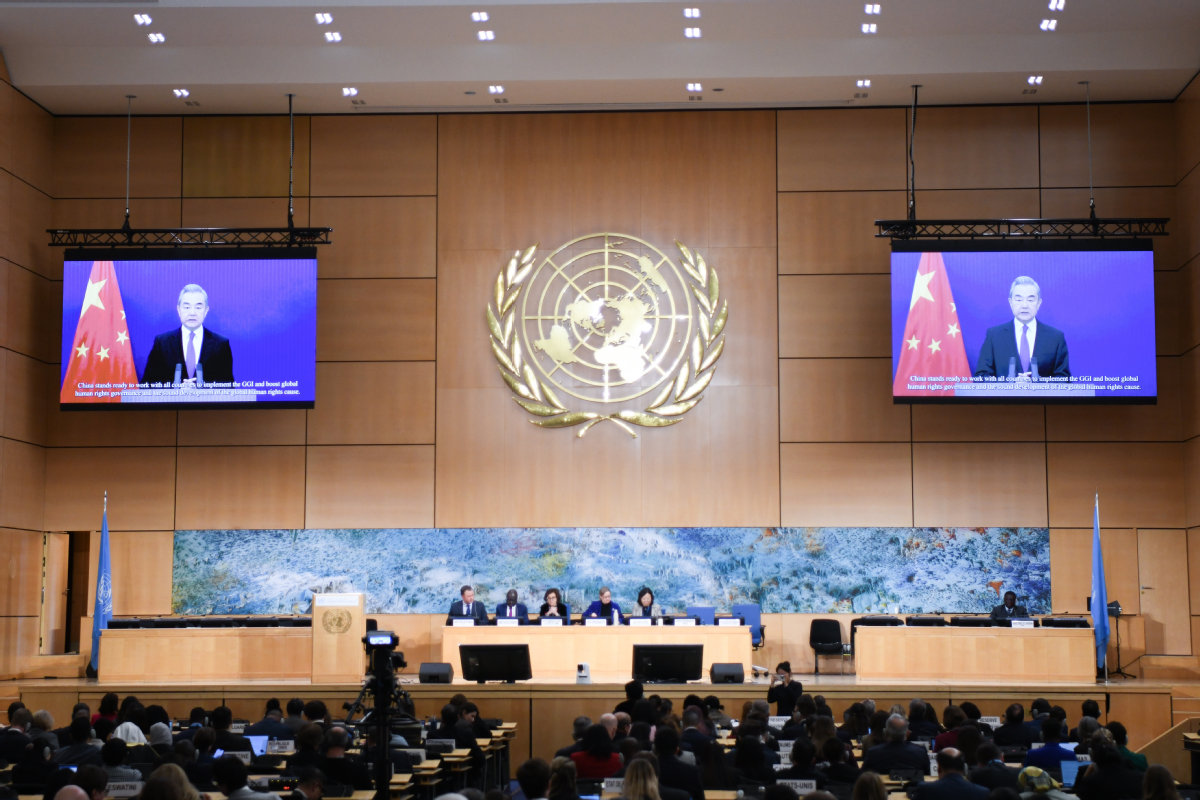
Chinese Foreign Minister Wang Yi delivers a video speech at the high-level segment of the 61st session of the United Nations Human Rights Council in Geneva on Feb 23. [Lian Yi / Xinhua]
Chinese Foreign Minister Wang Yi on Monday called for closer international coordination to improve global human rights governance, saying that China stands ready to work with all countries to implement the Global Governance Initiative and use it as an opportunity to refine global human rights governance.
He made the remarks in a video speech at the high-level segment of the 61st session of the United Nations Human Rights Council, or UNHRC, an intergovernmental body within the United Nations system responsible for promoting and protecting human rights in the world, held in Geneva. The high-level segment of UNHRC sessions is a forum that allows senior officials to outline national human rights priorities and set the session's political agenda.
Wang, who is also a member of the Political Bureau of the Communist Party of China Central Committee, noted that the international landscape is undergoing profound and complex changes. The post-World War II international order and the system of global human rights governance are, he said, currently facing new tests.
He highlighted the Global Governance Initiative proposed by President Xi Jinping, describing it as offering "Chinese wisdom" to guide the future direction of global human rights governance. To do this, Wang outlined five principles that should be observed.
First, he called for upholding sovereign equality for global human rights governance. There is no one-size-fits-all model of human rights governance, he said. Only development paths rooted in a nation's specific conditions and aligned with its people's needs can continue to broaden and succeed. Wang urged efforts to build a just, reasonable and inclusive global human rights governance system and to better heed the voices and demands of the Global South.
Second, he emphasized adherence to the international rule of law as the foundation of global human rights governance. Wang stressed that countries should jointly uphold the "golden rule" of non-interference in others' internal affairs, and firmly reject double standards or the politicization of human rights issues.
Third, Wang called for practicing multilateralism to address challenges in global human rights governance. Noting that 2026 marks the 20th anniversary of the establishment of the Human Rights Council, he said countries should take the occasion to abandon all forms of colonialism and racial discrimination and to properly address emerging issues such as Artificial Intelligence and climate change, and their implications for human rights.
Fourth, he advocated a people-centered approach to enrich the substance of global human rights governance. This year also marks the 40th anniversary of the adoption of the Declaration on the Right to Development, he noted, saying that the international community should prioritize the right to development on the multilateral human rights agenda and ensure that progress in human rights is visible, tangible and accessible to all.
Fifth, Wang underscored the importance of action-oriented efforts to enhance the effectiveness of global human rights governance. He cited China's achievements over the past year, including hosting a global women's summit and promoting the adoption of resolutions at the Human Rights Council on advancing human rights through development and on economic, social and cultural rights. China has also shared its human rights philosophy and practices and created new platforms for talent training and capacity-building in developing countries, he said.
"China is willing to coordinate actions with the international community to jointly draw a new blueprint for the global human rights cause," Wang said. He noted that 2026 marks the opening year of China's 15th Five-Year Plan period, 2026-30, adding that China will continue to develop whole-process people's democracy and ensure that the achievements of Chinese modernization benefit all people more fairly.
Yan Xiaoxiao, an associate researcher at the Institute of International Relations at the Shanghai Academy of Social Sciences, said Wang's speech comprehensively elaborated on China's approach to global human rights governance, characterized by safeguarding human rights through security, promoting human rights through development and advancing human rights through cooperation.
Hearing such an eloquent voice from China's foreign minister on the global human rights stage reflects the country's continued progress in the field and demonstrates its growing influence in international human rights affairs, Yan said.
Song Luzheng, a researcher at the China Institute of Fudan University based in France, said that Wang's speech outlined a human rights governance path with Chinese characteristics, which, compared with the West, places greater emphasis on sovereignty and the right to development.
"The East and the West do not fully share the same understanding of human rights," he told China Daily. "The annual sessions of the UNHRC provide an effective platform for exchanges between East and West on these differing concepts, and the Chinese foreign minister's speech here demonstrates China's progress and breakthroughs in human rights governance."
